Notes from the study as the season goes on: nest news, behaviour we did not expect, and what the sightings are adding up to.
Latest updates
9 October 2026
Two steps back, three steps forward — 11 active nests
It’s been three weeks since the last nest update, and it has been a case of two steps back and three steps forward.
New nests have been found, but some nests have also been abandoned. Sometimes, for whatever reason — partner didn’t like the quality of the sticks, or the view? — the birds choose to change address. Keeps us on our toes!
Net result: we’re sitting on 11 active nests.
So do please keep the sightings coming in. They play a massive role for us!
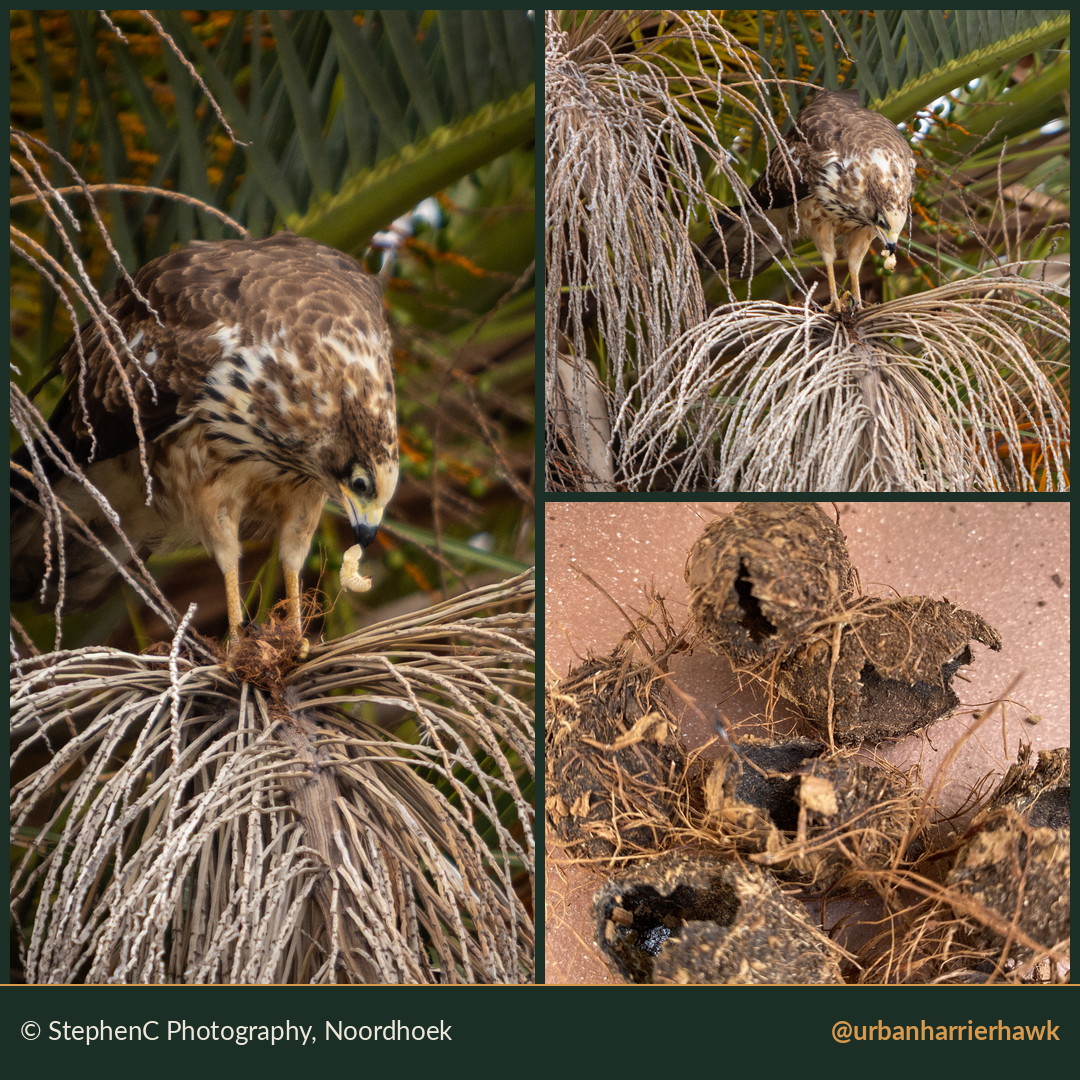
It’s not just nesting birds and small mammals that the African Harrier-Hawk extracts from palm trees. It also treats itself to the delicacy of palm tree weevils!
Some great photos from StephenC Photography showing a juvenile African Harrier-Hawk extracting the weevils from the casings and enjoying a treat. The third frame shows the opened casings left behind afterwards.
Here is something special. Virginie Harel filmed an adult working its way through a palm in Claremont, and being rewarded with a treat - a mouse!
Palms are a favourite hunting ground, and it is easy to see why. The skirt of dead fronds and the old leaf bases are full of places for rodents, geckos and insects to tuck themselves away — and the Harrier-Hawk’s long double-jointed legs are built for reaching into exactly those gaps.
Thank you to Virginie Harel for this outstanding footage.
Specialist hunters — and very few raptors can do this
We’re discovering just what amazing specialist hunters the African Harrier-Hawk are. Few raptors can do what these guys do — clamber up trees looking into every crevice. No animal or gogga is safe from them! Check how they use their unique legs and broad wings to brace up against the tree
Thank you to Heather and to Anet Nepgen for these fantastic videos.
And we’ve seen lots of activity around all of these nests, from refurbishing and mating to simply chilling in the nest. We’ve now hit the minimum target that makes the study viable.
But we still need plenty more nests to ensure we get a good understanding of these special birds. So our plea is that you continue to send in nest sightings, and any other sightings of the birds.
Look above in tall gum and pine trees — maybe you’re walking under one every day!
Juvenile raiding a Hadeda’s nest much to the distress of the Hadeda parents!
Here is some great footage from Robyn Beyers in Fish Hoek. A juvenile Harrier-Hawk decided to pay a visit to a Hadeda’s nest. Understandably Mom and Dad Hadeda did not appreciate the uninvited guest.
Eventually the Harrier-Hawk had enough of the unending HA! HA! HA! (like most of us) and took off for peace and quiet.
It has been two weeks since the launch of our public appeal for nests and sightings, and the support continues to be strong.
We now have 8 active nests!
Stretching from the northern suburbs all the way down to the southern suburbs. We are already learning lots from these 8 nests, so please do keep on spreading the news, logging the sightings and keeping an eye out for nests.
A special plea to those in Hout Bay and the Deep South — from Muizenberg to Simon’s Town, and Noordhoek. Plenty of sightings but no nests yet. The African Harrier-Hawks seem to be a lot more secretive down there!
Along with nest sightings, we’ve also had plenty of observations of pairs mating and flying with sticks to build nests. So things are getting busy in the Harrier-Hawk world!
Here are two short clips captured by Thato Sejake and Cheryl Kirsten of Harrier-Hawks getting ready for breeding season.
It’s been a week since we’ve gone live and the response from Capetonians has been phenomenal! Thank you to everyone who has submitted sightings — it all helps!
And the best news of all is that we’ve located more nests thanks to you.
Take a bow, Capetonians. We’ve got to keep looking for more though, so please don’t stop submitting your sightings.
A juvenile working a weaver colony — and thank you for the response
We have had an awesome response to the call for sightings. And some great photos and videos!
Here is a video submitted by Byron Rose with a juvenile African Harrier-Hawk showcasing its unique hunting skills. Broad wings for balance, long legs and double joints for clinging, and a long neck with a narrow head to get into those poor weaver nests for chicks. A ruthless hunter with unique hunting techniques!
The project is up, and we are looking for sightings and nests
This is the start of a study, an initiative of the FitzPatrick Institute of African Ornithology at UCT, into how the African Harrier-Hawk lives and breeds in Cape Town.
The first job is collecting sightings and finding active nests. Each one we locate becomes somewhere to watch across a season, which is how we get at the questions that matter: breeding success, hunting, feeding and other behaviour.
If you have seen an African Harrier-Hawk anywhere around Cape Town we would like to hear about it. Sightings without a nest still count. Repeated records in one area are usually what leads us to the nest in the end.
A running field diary. Nests confirmed, without locations. Behaviour worth recording. Prey items recorded. Photos and video sent in by observers. Short pieces on what the data is starting to show once there is enough of it to say anything.
If you would rather follow along on social media, the same updates go to Facebook and Instagram.
What we leave out
No nest location will appear on this page. Posts describe findings in general terms. We might say “a pair in the southern suburbs”. We will never name a street, a park or a map point. Photographs get checked before they go up so that no identifying landmark is showing. Raptor nests are vulnerable to disturbance and to deliberate harm, and no update is worth that.